

Industrial water treatment is a key process for complying with environmental regulations and improving operational efficiency. One of the most common problems in these applications is foaming, which can cause inefficiencies, increase costs and affect process safety.
In this article we explore what are foams in industrial water treatment, their types and the most effective strategies for their control with the use of TU-FOAM industrial water treatment defoamers.
What is foam in industrial water treatment?
Foam in industrial water treatment processes is a dispersion of gas in a liquid, caused by agitation, chemical reactions or biological activity. While some foams are transient, others can be persistent and problematic. For a foam to persist, three factors are required:
- Gas source (air or gases generated by chemical or biological reactions).
- Mixing energy that disperses the gas in the liquid.
- Stabilizing agents that prevent bubble breakage.
Foams usually appear in waters with organic contamination or suspended solids and in systems with high turbulence.
Types of foam in industrial water treatment
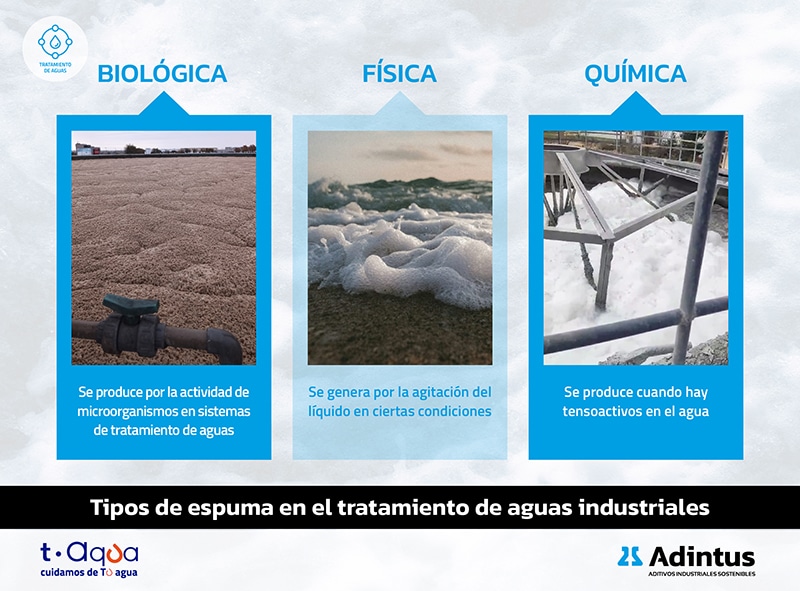
Industrial foams can be classified into three main types:
Biological foam
It is produced by the activity of microorganisms in water treatment systems, directly or indirectly. Common examples include:
- Bacterial by-products: Some bacteria in waste treatment systems can produce organic by-products, which tend to foam and emit gases such as CO2, which initiate the foaming condition.
- Filamentous bulking: Also known as sludge swelling. Occurs when microorganisms in a stressed environment release exopolymers that trap air, forming persistent foams.
Physical foam
It is generated by the agitation of the liquid under certain conditions. It is common in treatment plants and hydraulic systems, especially when there are high concentrations of dissolved solids (TDS), which alters the surface tension and promotes foaming.
Chemical foam
It is produced when surfactants are present in the water. They are dense and persistent foams, favored by high concentrations of dissolved solids and chemicals.
Strategies for foam control in industrial water treatment
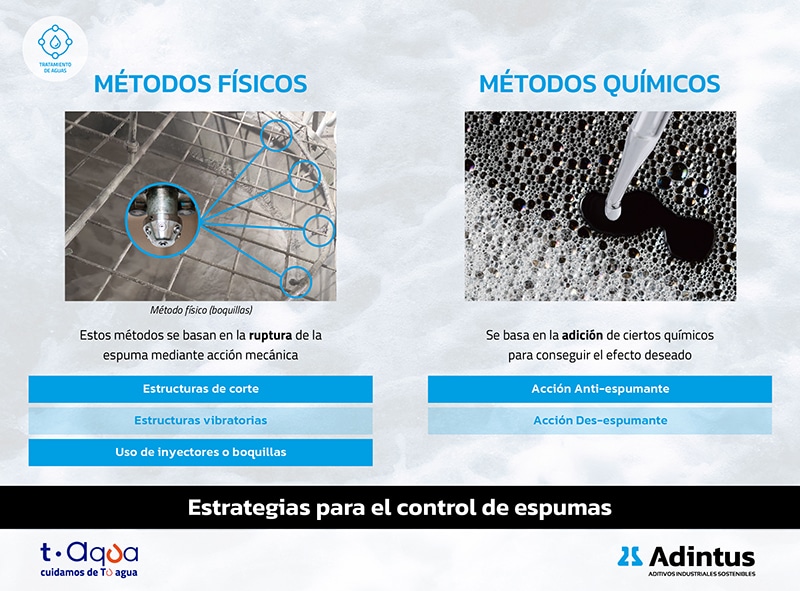
The presence of foam in water treatment plants can affect efficiency, safety and environmental compliance. There are two main approaches to its control:
Physical methods
These methods are based on the breaking of the foam by mechanical action:
- Shear structures which cause abrupt changes of direction in the fluid causing the occluded air to be released, breaking the foam.
- Vibrating structures which break the bubbles by applying pressure waves (a special case are ultrasound applications to break the front of foams).
- Use of injectors or nozzles which, above or below the foam layer, project jets of fluid that reproduce the aforementioned cutting patterns.
These methods are effective, but their impact is temporary since once the physical method is removed the foam will appear immediately.
Chemical methods
In this section we will discuss an approach to foam control that is based on the addition of certain chemicals to achieve the desired effect.
Before starting to develop this aspect, it should be pointed out that the foam control action can have two mechanisms:
- Anti-foaming actionadditives that prevent the appearance of foam.
- De-foaming action: Additives that break the foam once it appears.
Antifoaming and defoaming action can occur simultaneously. Antifoaming involves the prevention of foam formation by removing entrained gas that is present below the liquid surface, while defoaming involves the removal of foam from the surface. The surfactant materials in industrial foam control additives work by weakening the bubble film and causing small bubbles to coalesce into larger ones that break easily at the liquid surface.
Types of defoamers for industrial water treatment
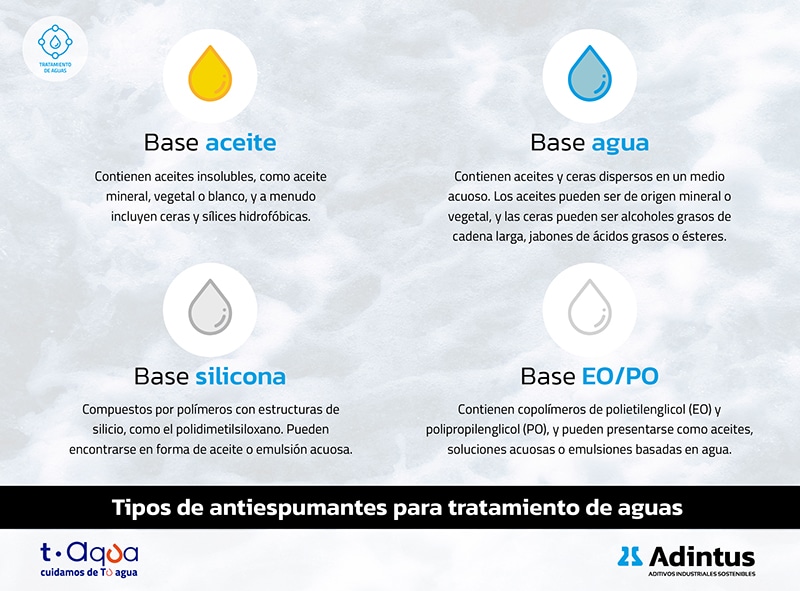
- Oil-based: contain insoluble oils, such as mineral, vegetable or white oil, and often include hydrophobic waxes and silicas. They are effective in removing surface foam and are used in a variety of industries under high temperature conditions.
- Water-based: They contain oils and waxes dispersed in an aqueous medium. The oils can be of mineral or vegetable origin, and the waxes can be long-chain fatty alcohols, fatty acid soaps or esters. They are useful for releasing air trapped in liquids.
- Silicone base: Composed of polymers with silicon structures, such as polydimethylsiloxane. They can be found in oil or aqueous emulsion form. They are very resistant and effective both in the elimination of surface foam and in the release of trapped air.
- EO/PO base: They contain copolymers of polyethylene glycol (EO) and polypropylene glycol (PO), and can be presented as oils, aqueous solutions or water-based emulsions.
The choice of defoamer depends on water composition, operating conditions and environmental regulations.
TU-FOAM: the sustainable choice in defoamers for industrial water treatment
Foam control should not only focus on efficiency, but also on sustainability. TU-FOAM® industrial water treatment defoamers are an innovative solution that combines performance and environmental friendliness. defoamers are an innovative solution that combines performance and environmental friendliness. Its benefits include:
- Biodegradable formulas: Reduce environmental impact.
- High compatibility: They work in various industrial conditions.
- Cost reduction: Minimizes downtime and maintenance.
- Regulatory compliance: Ensures compliance with environmental regulations.
How to choose the right defoamer?
To select the best product, it is important to consider:
- Water composition: Types of contaminants present.
- Operating conditions: Temperature, pH and agitation.
- Local regulations: Regulations for use in each industry.
Conclusion
Foam control is critical in industrial water treatment. Choosing the right strategy can improve process efficiency and reduce environmental impacts. TU-FOAM® defoamers for industrial water treatment are an innovative solution that allows companies to optimize their operations in a sustainable way. defoamers are presented as an innovative solution that allows companies to optimize their operations in a sustainable way.


