What is the coagulation and flocculation process?
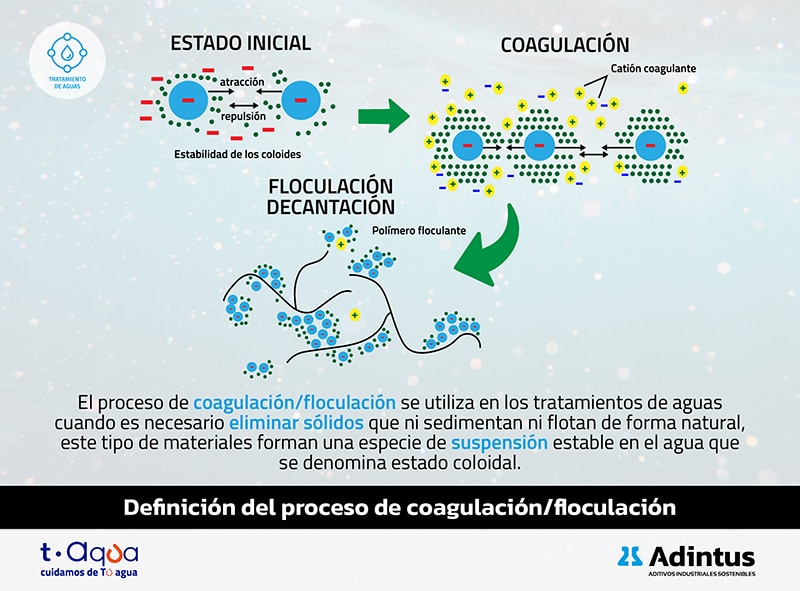
The coagulation/flocculation process is used in water treatment when it is necessary to remove solids that neither settle nor float naturally, this type of material forms a kind of stable suspension in the water, which is called colloidal state.
Traditionally, this process has consisted of incorporating chemicals of inorganic origin, usually iron and aluminum salts, which cause the colloidal solids to cancel their negative charge, the electrostatic repulsion between them to disappear and thus form clots, which will increase in size.
If necessary, and at a later stage, flocculants of polymeric origin are added, thus forming aggregates of coagulates of such a size that they can be removed either by sedimentation in decanters or by air injection in flotation equipment.
Types of coagulants
There are several types of coagulants for wastewater treatment that help remove suspended solids. Below, we will detail what they are and their main advantages and disadvantages.
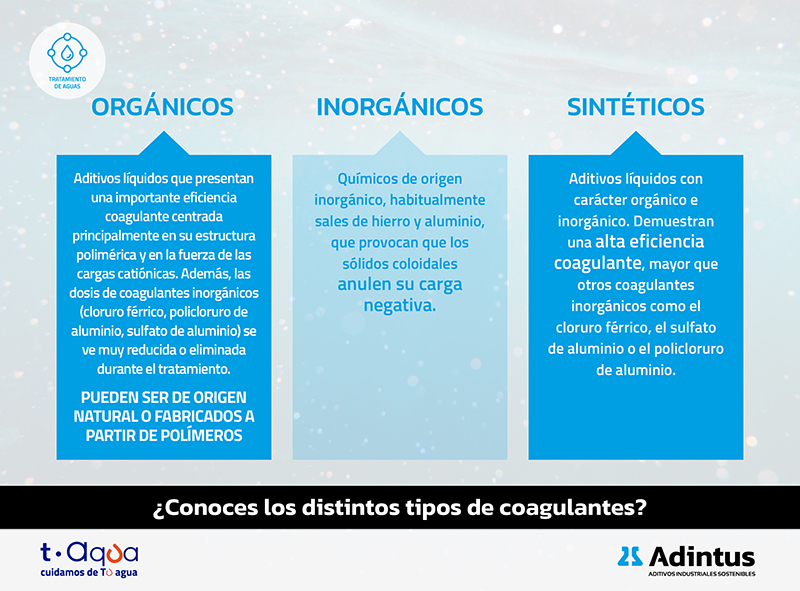
- Inorganic coagulants. They are chemicals of inorganic origin, usually salts of iron and aluminum, which cause the colloidal solids to cancel their negative charge.
- Organic coagulants. They are liquid additives with a significant coagulating efficiency mainly focused on their polymeric structure and on the strength of the cationic charges. In addition, the doses of inorganic coagulants (ferric chloride, aluminum chloride, aluminum sulfate) are greatly reduced or eliminated during treatment. They can be of natural origin or manufactured from polymers.
- Synthetic coagulants. They are liquid additives with organic and inorganic character. They show a high coagulating efficiency, higher than other inorganic coagulants such as ferric chloride, aluminum sulfate or aluminum polychloride.
The inorganic coagulants have numerous disadvantages
These inorganic chemicals, in addition to being highly pH-dependent, incorporate metallic salts into the water, hindering subsequent biological processes and adding conductivity, as well as other drawbacks:
- Require pH control devices
- Removal of organic matter is more limited
- Not as efficient with high turbidity waters
- Often requires a flocculation aid (polymer) to flocculate.
- Can cause color and precipitation in treated water.
- Corrosives for handling and storage
What are natural organic coagulants TU-CLUST?
From Adintus, we promote the TU-CLUST line of coagulants, coagulants of natural origin that are a series of specific coagulants to treat wastewater, and are mainly composed of polymers of natural origin extracted from plants. These compounds are mainly polysaccharides, polyphenols and peptides and other water-soluble substances that act as coagulation and/or flocculation agents.
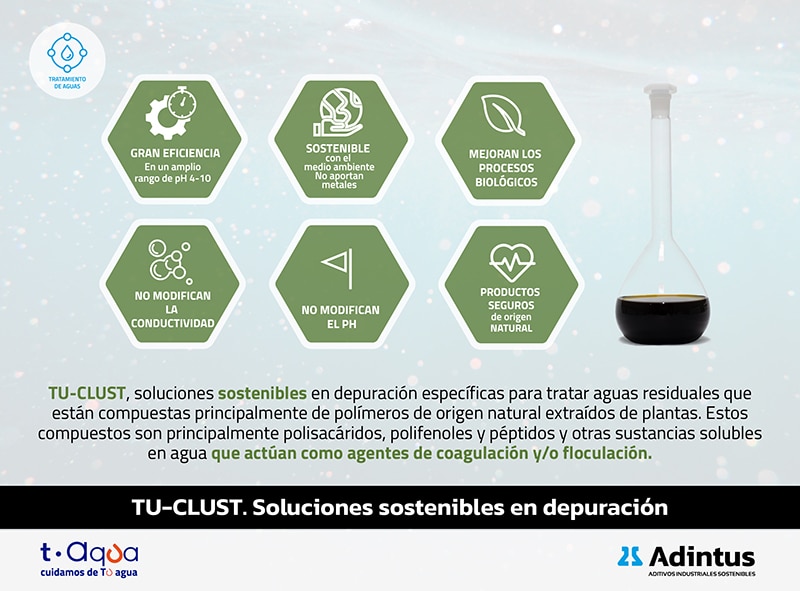
What are the advantages of applying natural organic coagulants in industrial wastewater treatment?
These types of sustainable additives have numerous benefits and are committed to environmental sustainability by reducing consumption, protecting the environment and treatment facilities.
- Higher efficiency compared to traditional inorganic coagulants.
- Null contribution of salts, so that the conductivity is not altered, thus achieving a higher rate of reuse of treated water.
- Wide pH range of use being able to be used below 5 upH and above 9.5 upH. This also helps to avoid having to use pH adjustments in its use, so we do not add inorganic salts.
- Natural coagulants, being natural polymers, do not modify the pH of the water to be treated and even though they are acidic products, it is not necessary to use alkalizing products such as sodium or calcium hydroxide.
- Wastewater treatment is more cost-effective, as it reduces the cost of treatment by not using soda or lime to adjust the pH. In addition, it usually reduces the amount of flocculant to be used compared to the same treatment with traditional coagulants.
- As it does not contain metals in the form of inorganic salts, the sludge generated is less hazardous, reducing waste management costs. It also favors the valorization of sludge for agricultural use.
- The use of natural coagulants is safer for the environment by not adding metal salts and for people, as they are not corrosive or hazardous to health. In addition, natural coagulants are environmentally friendly, as they are composed of natural and sustainable polymers throughout their life cycle.
- Natural coagulants, since they do not contain inorganic metal salts, prevent machinery deterioration, resulting in lower maintenance costs.
- As they do not contain inorganic metal salts, they produce smaller volumes of sludge, which is less toxic and therefore more economical to manage.
- Due to their structure, some natural coagulants have a certain biocidal power, as they have the ability to fight microbes, thus reducing or eliminating the content of pathogenic microorganisms susceptible to produce diseases.