What is the Green Deal?
The Green Deal, or “European Green Pact”, is a political and strategic initiative launched by the European Commission. Its main objective is to make the European Union the first climate-neutral continent by 2050, driving a cleaner and more sustainable economy. The Green Deal aims to be a comprehensive roadmap guiding the transformation towards a greener and more sustainable economy, while ensuring a fair and equitable transition for all citizens and economic sectors.
This ambitious plan aims to address both climate change and related environmental and social challenges. It focuses on key areas such as energy, mobility, agriculture, construction and industry, among others, in order to reduce greenhouse gas emissions and promote sustainable economic growth.
Importance of the chemical sector in the EU Green Deal
The chemical sector is positioned as a fundamental pillar in the implementation of the European Union’s Green Deal, an ambitious strategy that seeks to transform the European economy into a greener, more sustainable and environmentally friendly one. This relevance is due to various reasons ranging from its innovative capacity to its ability to adapt to more sustainable models.
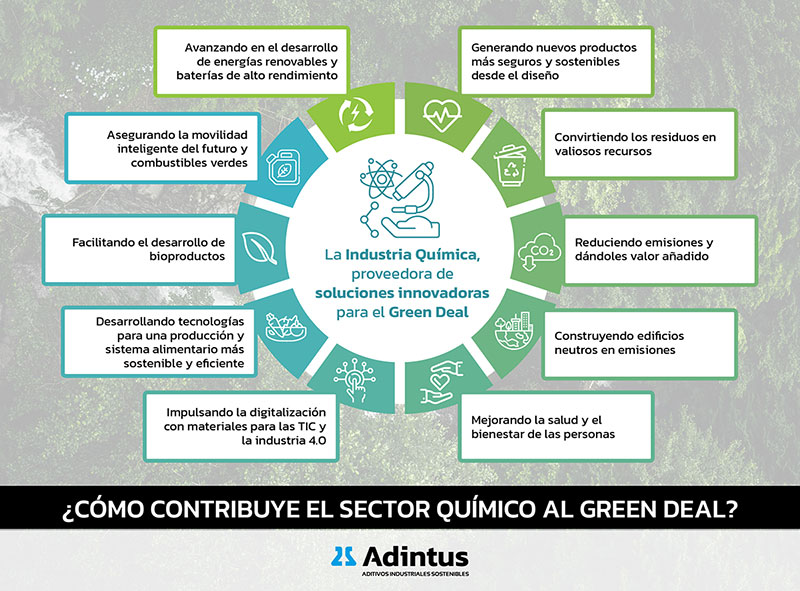
The main areas of emphasis for the chemical sector are innovation and technological development, energy efficiency and emissions reduction, the circular economy and the development of renewable energies.
Actions that promote the Green Deal
Here are some ways in which the chemical sector can contribute to the Green Deal.
- Innovation in sustainable materials: The chemical sector can develop and produce more sustainable materials, such as biodegradable plastics, recyclable polymers, and chemicals derived from renewable sources instead of fossil fuels.
- Energy efficiency and emissions reduction: Chemical companies can implement more energy-efficient technologies in their production processes to reduce their carbon footprint and other polluting emissions.
- Circular economy: The chemical sector can adopt circular economy models, where chemicals and materials are recycled and reused rather than discarded after use, reducing the amount of waste and reducing the need for virgin raw materials.
- Renewable energy development: The chemical industry can contribute to the development and implementation of renewable energy technologies, such as solar and wind energy, which can be used in production processes and reduce dependence on fossil fuels.
- Research and development of environmental solutions: The chemical sector can invest in research and development of technologies and solutions that address specific environmental challenges, such as water and air pollution, hazardous waste management, and climate change mitigation.
In summary, the chemical sector has a key role to play in the transition to a greener and more sustainable economy, and can contribute significantly to the achievement of the objectives set out in the EU Green Deal through innovation, energy efficiency, the circular economy and the development of environmental solutions.